

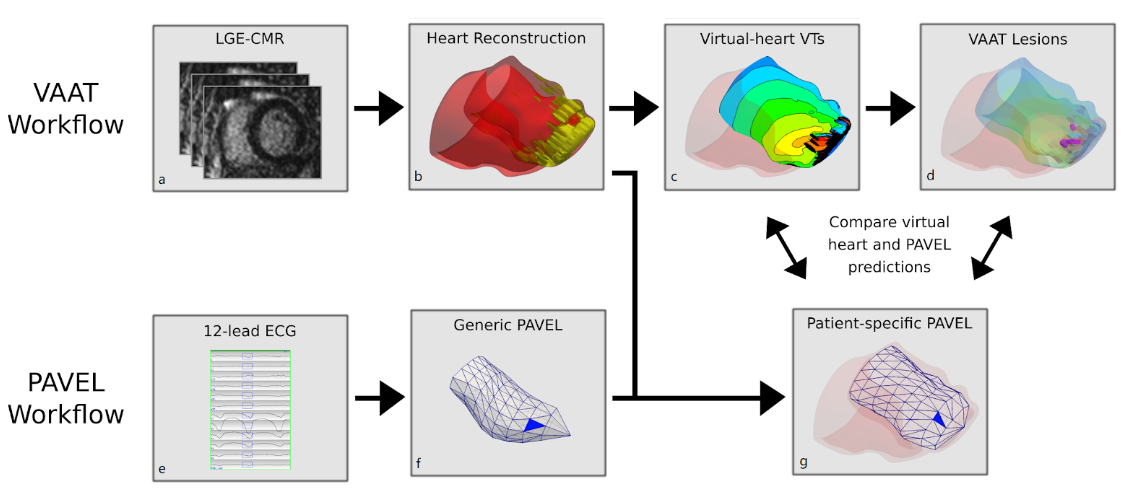
VAAT and PAVEL Workflow
We recently developed two non-invasive methodologies to help guide VT ablation: population-derived automated VT exit localization (PAVEL) and virtual-heart arrhythmia ablation targeting (VAAT). We hypothesized that while very different in their nature, limitations, and type of ablation targets (substrate-based vs. clinical VT), the image-based VAAT and the ECG-based PAVEL technologies would be spatially concordant in their predictions. This project is to test this hypothesis in ischemic cardiomyopathy patients in a retrospective feasibility study.
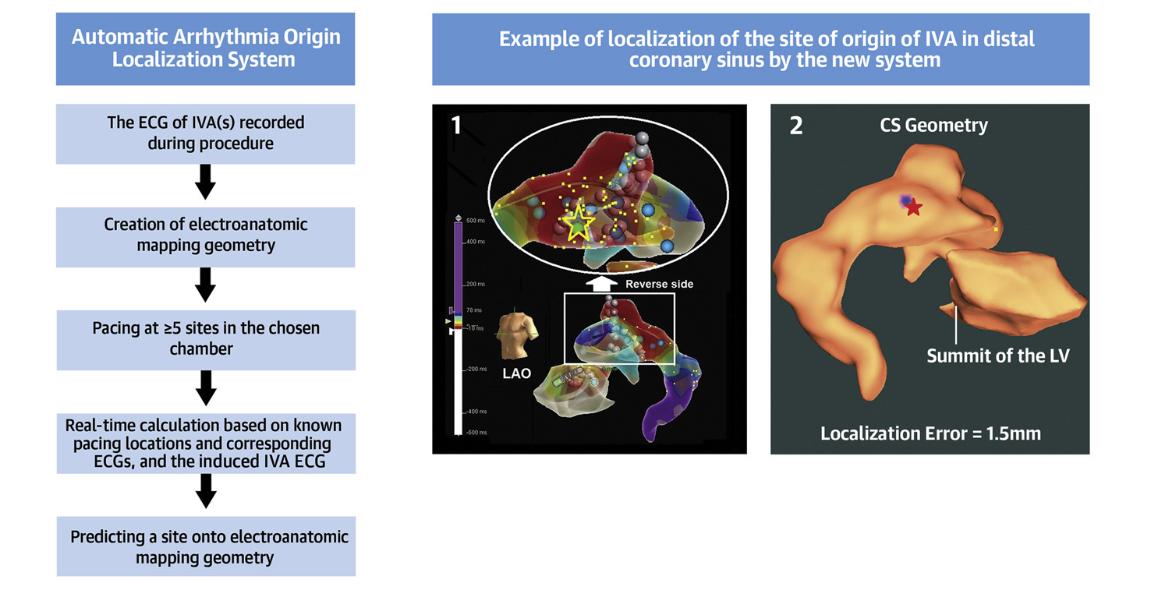
Automatic Arrythmia Origin Localization
Prior site of origin systems to identify idiopathic ventricular arrhythmias (IVA) are limited by the need to create complete electroanatomic maps (EAM), inability to localize intracardiac structures/vessels and require pre-procedural cardiac imaging. Our Automatic Arrhythmia Origin Localization (AAOL) system addresses these issues. The AAOL system combines 3-lead, 120-ms QRS integrals with pace mapping to predict the site of earliest ventricular activation and project that site onto patient-specific EAM geometry. In a prospective, multicenter study of patients undergoing IVA catheter ablation, twenty-three IVA origin sites were localized by the AAOL system with a mean localization accuracy of 3.6 mm, better than any prior published system.
 CCCEL
CCCEL 